How to integrate Angular with GraphQL API
Integrating Angular with a GraphQL API requires Apollo Client, which provides caching, reactive queries, and typed operations that REST clients lack.
As the creator of CoreUI with Angular development experience since 2014, I’ve used Apollo Angular in enterprise dashboards where the flexibility of GraphQL significantly reduced over-fetching and simplified data management.
The setup involves installing Apollo Angular, configuring the client with your GraphQL endpoint, and using the Apollo service to execute queries and mutations in your components.
Once configured, Apollo handles caching and state management for you automatically.
How to integrate Angular with REST API
Integrating Angular with a REST API is a fundamental task in every enterprise application, and doing it correctly requires understanding Angular’s HttpClient module and RxJS observables.
As the creator of CoreUI and an Angular developer since 2014, I’ve built REST integrations for dozens of production dashboards and admin panels.
The cleanest approach is to encapsulate all HTTP calls in a dedicated service, inject it into components, and handle responses reactively using RxJS operators.
This keeps components focused on presentation and makes API logic easy to test.
How to print table in Angular
Printing data tables from Angular applications requires hiding navigation elements and applying print-friendly styles.
As the creator of CoreUI, I’ve implemented print functionality for reports, invoices, and data exports in enterprise dashboards.
The standard approach triggers window.print() while CSS @media print rules hide non-printable elements and format the table for paper.
This works without any libraries and produces clean printed output.
CoreUI for Angular v5.6.20 - Angular 21.2.3 Security Update

We are pleased to announce the release of CoreUI for Angular v5.6.20. This important security update brings full support for Angular 21.2.3, includes critical security patches for the hono package vulnerability (GHSA-v8w9-8mx6-g223), and comprehensive dependency updates to ensure your Angular applications run securely with the latest framework improvements.
CoreUI PRO for Angular v5.6.20 - Angular 21.2.3 Security Update
We are pleased to announce the release of CoreUI PRO for Angular v5.6.20. This important security update brings full support for Angular 21.2.3, includes critical security patches for the hono package vulnerability (GHSA-v8w9-8mx6-g223), and comprehensive dependency updates to ensure your enterprise Angular applications run securely with the latest framework improvements.
How to export table data in Angular
Exporting table data to CSV or JSON lets users take data out of web applications for further processing. As the creator of CoreUI, I’ve implemented data export for reporting dashboards where users need to analyze data in Excel or share it with colleagues. The standard approach builds the file content as a string, creates a Blob, and triggers a download via a temporary anchor element. This works without any server-side code or third-party libraries.
How to filter tables in Angular
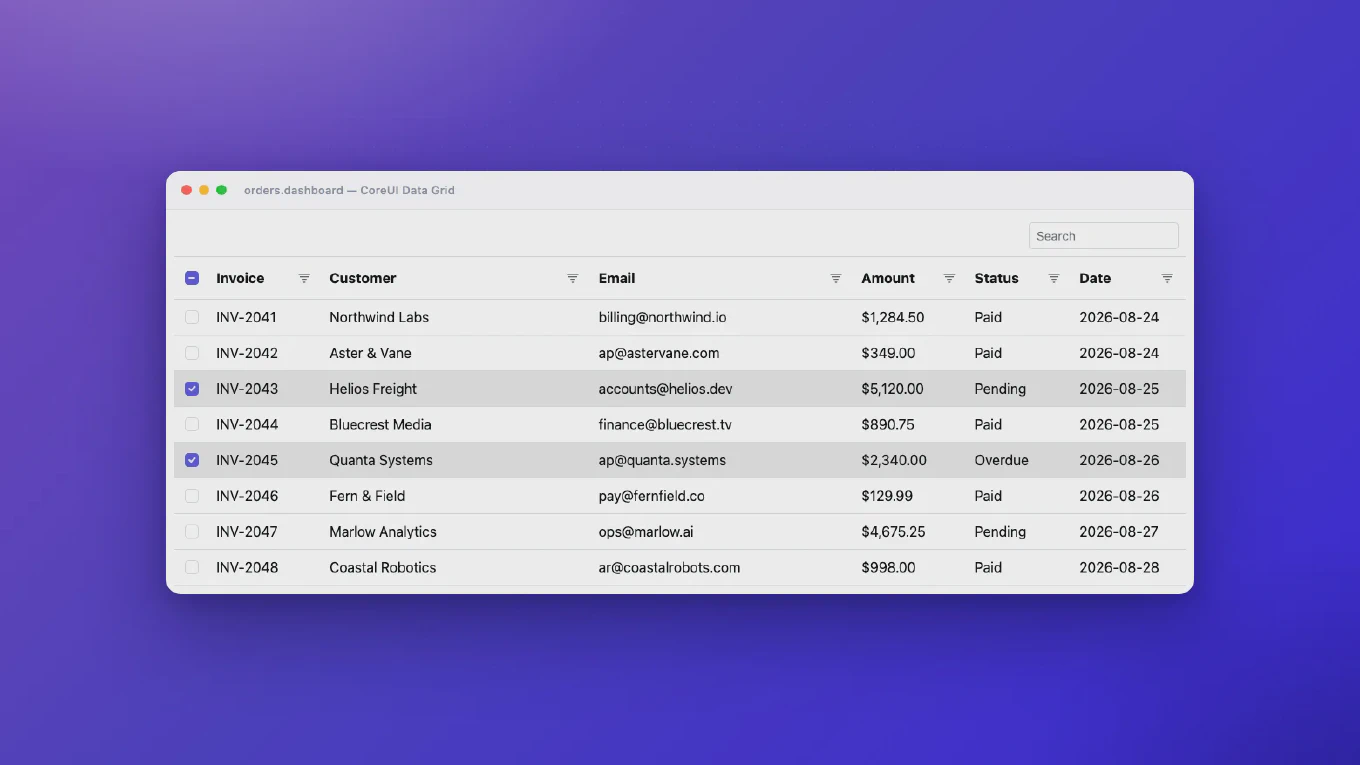
Filtering tables lets users find records quickly without scrolling through entire datasets.
As the creator of CoreUI, I’ve implemented table filtering for enterprise dashboards managing thousands of records.
The most effective approach uses a reactive search input bound with [(ngModel)] and a getter that filters the display data.
This provides instant, responsive filtering with no extra libraries.
How to sort tables in Angular
Sortable tables help users find data quickly by ordering rows based on any column. As the creator of CoreUI, I’ve built sortable data tables for enterprise dashboards handling thousands of rows. The most effective approach tracks sort column and direction in component state, uses a getter to return sorted data, and shows directional indicators on column headers. This provides intuitive sorting without external libraries.
CoreUI for Angular v5.6.19 - ESLint 10 Update
We are pleased to announce the release of CoreUI for Angular v5.6.19. This maintenance update brings support for ESLint 10, updates to the latest Angular 21.2.1 tooling, and comprehensive development dependency updates to enhance your Angular development experience.
CoreUI PRO for Angular v5.6.19 - ESLint 10 & Tooling Updates
We are pleased to announce the release of CoreUI PRO for Angular v5.6.19. This maintenance update brings support for ESLint 10, updates to the latest Angular 21.2.1 CLI and build tools, and comprehensive development dependency updates to enhance your enterprise Angular development experience.