Bootstrap Calendar: From Date Picker to Full Scheduler
 Łukasz Holeczek
Follow Łukasz Holeczek on GitHub
Connect with Łukasz Holeczek on LinkedIn
Follow Łukasz Holeczek on X (Twitter)
Łukasz Holeczek
Follow Łukasz Holeczek on GitHub
Connect with Łukasz Holeczek on LinkedIn
Follow Łukasz Holeczek on X (Twitter)
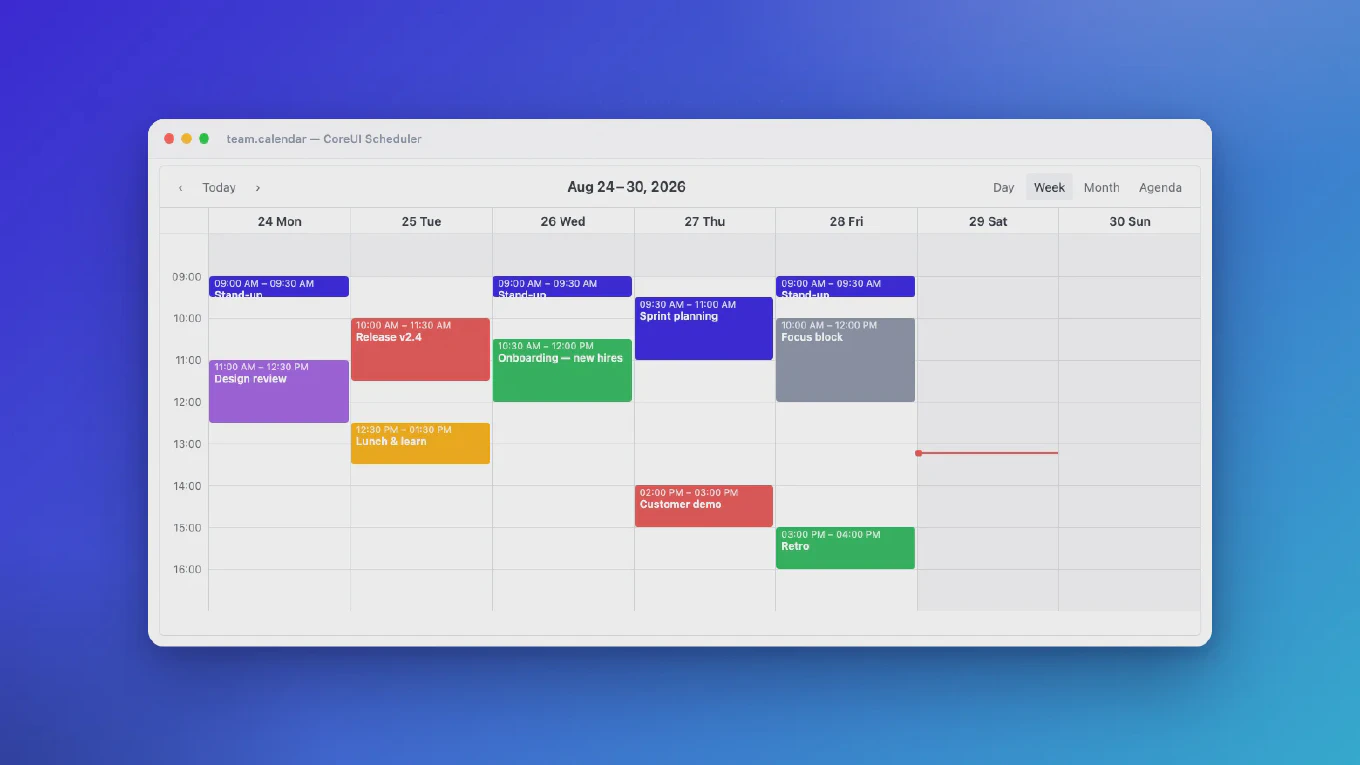
“Add a calendar” is one of those requirements that means five different things depending on who says it. A form field for picking a delivery date is a calendar. A month grid showing this sprint’s deadlines is a calendar. A week view where a dispatcher drags jobs between technicians’ columns is also, apparently, a calendar.
These are not sizes of the same feature — they are different features with different costs, and Bootstrap itself ships none of them. Bootstrap 5 has no calendar component at all: no date picker, no month grid, no scheduler. So every “bootstrap calendar” is Bootstrap’s design language plus a component that comes from somewhere else — a library, or your own code.
This article climbs that ladder honestly: what each rung actually requires, what you can reasonably build yourself, and where the cost curve bends hard enough that building stops making sense.
Speed up your responsive apps and websites with fully-featured, ready-to-use open-source admin panel templates—free to use and built for efficiency.
Rung 1: picking a date
The most common need is also the cheapest: a user has to select a date, a week, or a month, and you want it to look like the rest of your Bootstrap 5 UI.
This rung is a solved problem. CoreUI — the component library that maintains Bootstrap-compatible components — ships a Calendar component that renders a Bootstrap-styled calendar from a data attribute, with day, week, month, and year selection modes, locale support, week numbers, and disabled-date rules:
<div
  class="border rounded"
  data-coreui-locale="en-US"
  data-coreui-start-date="2026/09/14"
  data-coreui-toggle="calendar"
></div>
For forms there is the matching
Date Picker — the
same calendar attached to an input, with localization and validation. To be
clear about what’s free and what isn’t: the documentation is open, but both
components ship as part of CoreUI PRO, the commercial tier of the library.
The free CoreUI package covers the Bootstrap-equivalent core components;
date components are where its paid tier begins. If you need a one-off date
field and won’t pay for anything, a plain <input type="date"> remains the
honest zero-cost answer — ugly, inconsistent across browsers, but free and
accessible.
Whatever you choose here, notice what this rung does not include: events. A date picker answers “which day?” — it displays nothing on the days themselves. The moment your calendar has to show things, you are on the next rung, and the cost profile changes completely.
Rung 2: the event calendar
A Bootstrap event calendar — a month grid with items on the days — looks
like an afternoon of work, and the first version genuinely is. A month view
is 42 cells; you can build it as a CSS grid, drop .badge elements into the
right cells, and it will demo well:
const first = new Date(year, month, 1)
const offset = (first.getDay() + 6) % 7   // week starts Monday
const cells = Array.from({ length: 42 }, (_, i) =>
  new Date(year, month, 1 - offset + i)
)
// render cells, then place each event into its day's cell by date key
The leaks on this rung are well known to everyone who has shipped one:
- Multi-day events. A three-day conference is not three badges — users expect one continuous bar spanning cells, which means row-based layout math, not per-cell insertion.
- Overflow. Six events on one day don’t fit in a cell; now you need “+3 more” logic and a popover.
- Week and day views. A month grid has no notion of time. The moment someone asks for “Tuesday, hour by hour”, you are building a second, completely different layout: a time axis, events positioned by minutes, and — the classic — overlapping events that must share column width side by side instead of stacking on top of each other.
- All-day vs. timed events need separate lanes, or the all-day items smear across your hour grid.
For a read-only calendar with modest traffic — a marketing site’s event list, a team’s deadline overview — a DIY month grid plus an agenda-style list for the details is a legitimate place to stop. The rung is climbable by hand. What actually ends the DIY path is not display. It is the next two requests, which tend to arrive in the same sentence.
Rung 3: “can I drag it?” — the scheduler threshold
A calendar becomes a scheduler when users stop reading it and start operating it: drag an event to another slot, resize it, drag across empty space to create one. This is the threshold where effort jumps an order of magnitude, for reasons that are invisible in a demo:
- Drag-and-drop on a time grid is not DOM dragging — it is a state machine (pressed → dragging → committed/cancelled) that converts pixels to minutes, snaps to a grid, auto-scrolls at the edges, and can revert cleanly when your server rejects the change.
- Every pointer interaction needs a keyboard equivalent with the same semantics, or you have shipped an inaccessible core workflow.
- Optimistic UI: the event moves immediately, persists asynchronously, and must jump back on failure without corrupting the view.
Rung 4: “…and make it repeat every second Tuesday”
Recurrence is the other half of the threshold, and it is deceptively deep. The standard that describes repeating events — RFC 5545, the iCalendar RRULE grammar — handles “every second Tuesday”, “last weekday of the month”, exceptions (“except Dec 24”), and series edits. Implementing it yourself is a known graveyard; the edge cases compound:
- DST. A 9:00 weekly stand-up must stay at 9:00 wall-clock after the
clocks change, and an occurrence landing in the spring-forward gap has to
resolve somewhere deterministic. Naive
Datearithmetic gets this wrong twice a year. - Series edits. When a user moves one occurrence, they must choose: just this one, this and following, or the whole series — and each answer splits or rewrites the series differently. Every user knows this dialog from Google Calendar; few teams budget for implementing what’s behind it.
- Windowed expansion. A rule with no end date describes infinitely many occurrences; a correct implementation only ever materializes the visible range.
If rungs 3 and 4 are in your requirements, you are no longer building a calendar. You are building a scheduling engine, and the build-vs-buy math that favored DIY on rung 2 has flipped.
Rung 5: resources — one column per room, person, or machine
The final rung is scheduling across something: exam rooms, technicians, rental cars. The canonical UI is a day view with one column per resource, where dragging an event into another column reassigns it. It inherits every problem from rungs 3–4 and adds its own: routing events to columns, per- resource coloring, and performance once you have more than a dozen columns — past that point the columns themselves need virtualization, exactly like rows in a large data grid.
What a Bootstrap scheduler looks like when you buy the ladder
This ladder — and the fact that people in the Bootstrap ecosystem kept climbing it by hand — is why we built CoreUI Scheduler. It is a full scheduling engine styled with CoreUI’s Bootstrap-compatible design tokens, so it lands in a Bootstrap 5 project without a visual seam:
new coreui.Scheduler(document.getElementById('scheduler'), {
  view: 'week',              // day, week, month, agenda, timeline, resource
  dayStartHour: 8,
  dayEndHour: 18,
  timeZone: 'Europe/Warsaw', // all wall-clock math, DST included, runs here
  events: [
    { id: 'standup', title: 'Stand-up',
      start: '2026-09-14T09:00', end: '2026-09-14T09:15',
      rrule: 'FREQ=WEEKLY;BYDAY=MO,WE,FR' },
    { id: 'review', title: 'Design review',
      start: '2026-09-15T10:00', end: '2026-09-15T11:30' },
  ],
})
The rungs map directly onto what it ships: drag to move, resize, and create
with snapping and edge auto-scroll; a keyboard path with the same semantics
as the pointer; every change emitted as a DOM event with a revert()
callback for server-rejected edits; recurrence as raw RFC 5545 RRULE
strings with exception dates, windowed DST-safe expansion, and the
this-one / this-and-following / whole-series edit dialog; and a resource
view with one column per resource, drag-to-reassign, and automatic column
virtualization past a dozen resources. Time arithmetic runs on the Temporal
API rather than Date, which is what makes the DST behavior a guarantee
instead of a hope.
Honest terms, same as everywhere in this article: CoreUI Scheduler is a commercial component — $199 during early access, $349 after release — and one license covers the JavaScript, React, Vue, and Angular editions, which share one core and one stylesheet.
Where to stop climbing
| You need | Honest answer |
|---|---|
| A date in a form | <input type="date"> if zero-cost wins; CoreUI Calendar / Date Picker (part of CoreUI PRO) if it must match your Bootstrap UI. |
| A read-only month grid with a few events | Build it — a CSS grid of 42 cells plus an agenda list is a fine afternoon project. |
| Week/day views, overlapping events, multi-day bars | Buildable, but budget weeks, not days — layout math is the whole job. |
| Drag-and-drop, recurring events, resource columns | Buy the engine. This is CoreUI Scheduler’s rung — or any comparable scheduling engine; just don’t hand-roll RFC 5545. |
The pattern across the ladder is consistent: display is cheap, interaction is expensive, and time itself — recurrence, zones, DST — is the most expensive of all. Pick your rung deliberately, and spend your own engineering only below the threshold where the sentence “can I drag it, and can it repeat?” appears.