How CoreUI Pro Next.js Boilerplate helps teams ship faster in production
 Łukasz Holeczek
Follow Łukasz Holeczek on GitHub
Connect with Łukasz Holeczek on LinkedIn
Follow Łukasz Holeczek on X (Twitter)
Łukasz Holeczek
Follow Łukasz Holeczek on GitHub
Connect with Łukasz Holeczek on LinkedIn
Follow Łukasz Holeczek on X (Twitter)
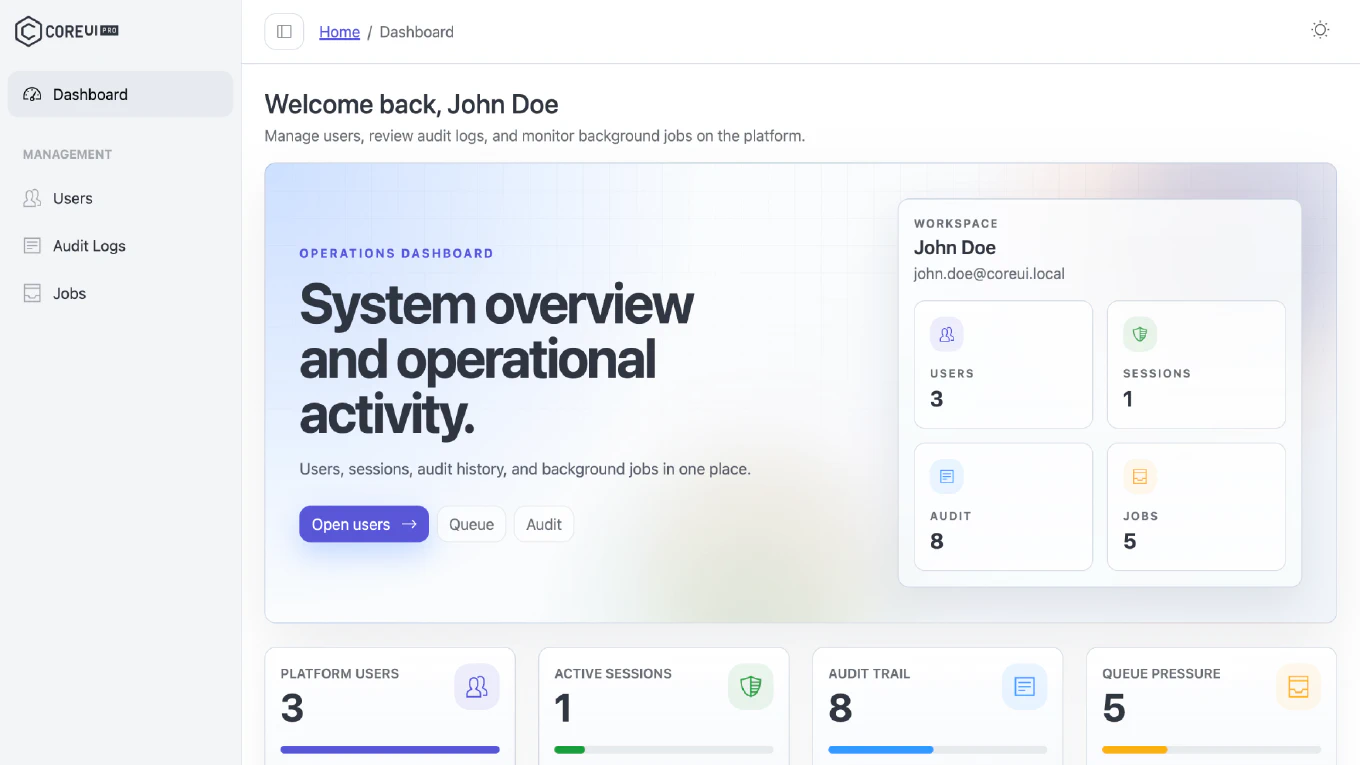
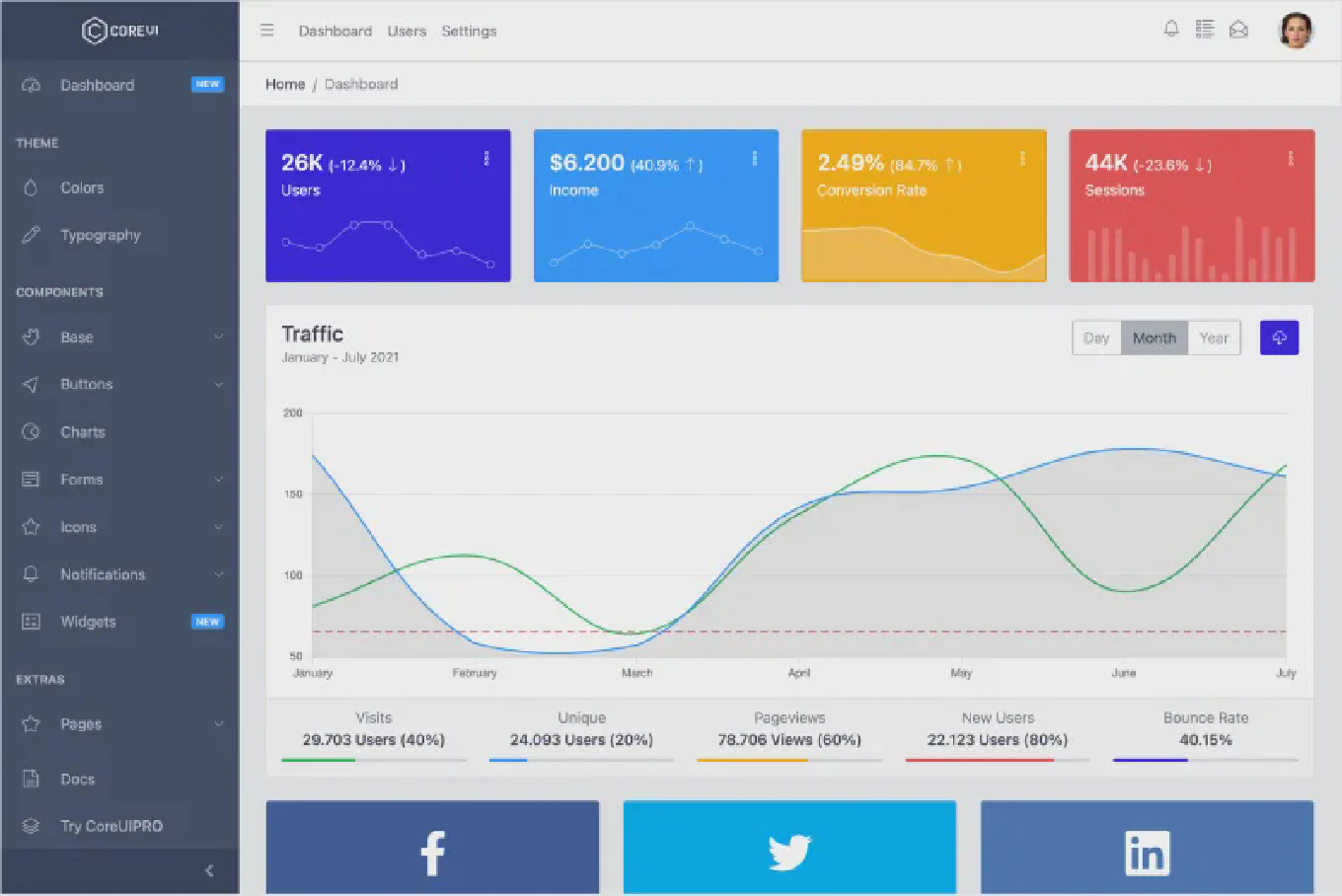
Shipping an internal tool or admin panel faster is rarely about writing more code — it is about writing less of the infrastructure code that every screen depends on but none of the product requirements mention. CoreUI Pro Next.js Boilerplate is built on that premise: it is not a starter template with polished screenshots, but a production-oriented application foundation with authentication, RBAC, and the structural patterns teams otherwise spend weeks assembling before touching a single product feature. That changes the buying criteria. Instead of comparing screenshots, teams should compare delivery speed, maintainability, access control, and how quickly the first real screen ships.
Speed up your responsive apps and websites with fully-featured, ready-to-use open-source admin panel templates—free to use and built for efficiency.
A working application foundation, not just polished screens
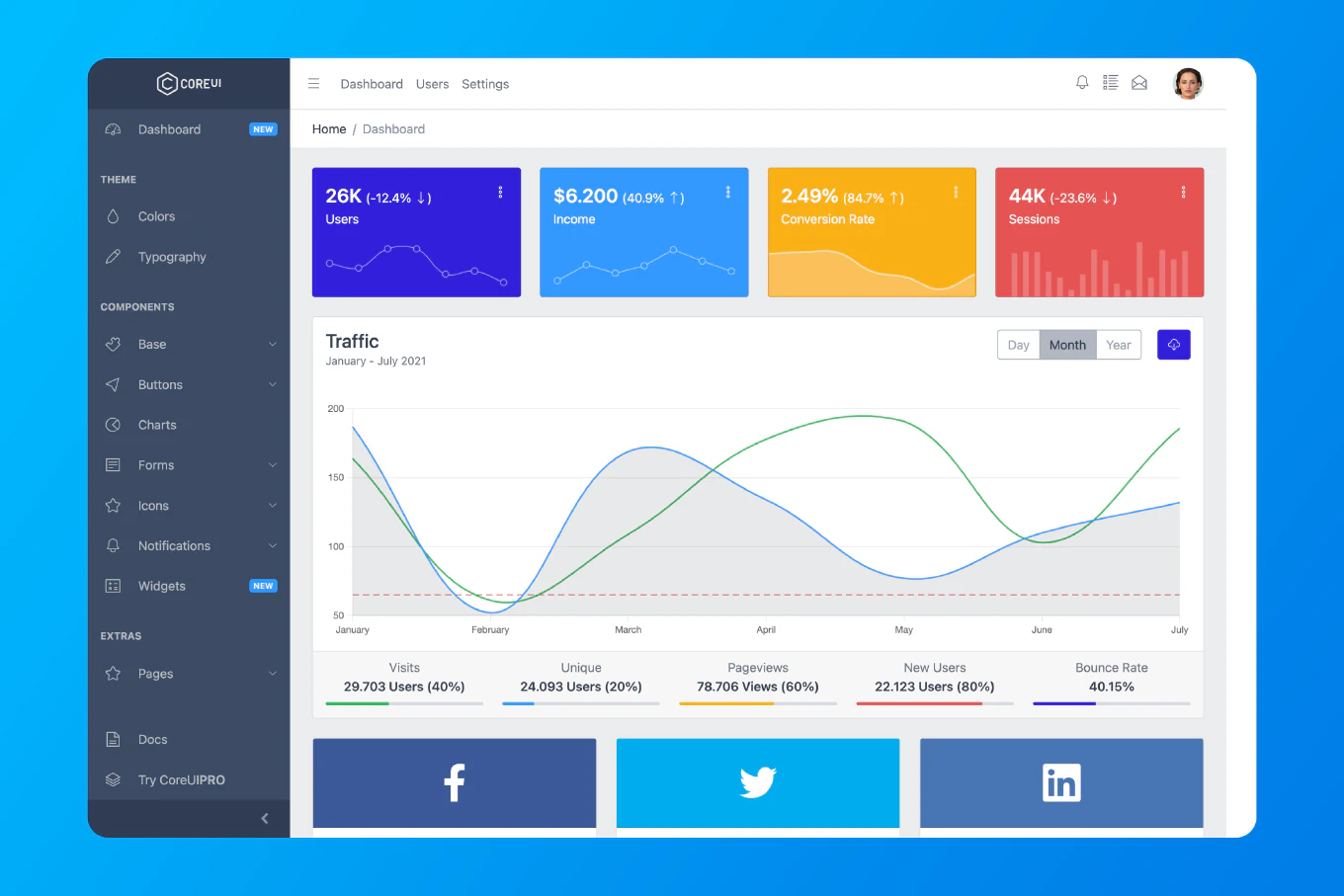
Most UI kits give you components. CoreUI Pro Next.js Boilerplate gives you a working application structure built on top of those components — one where authentication, role-based access control, navigation, and layout decisions have already been made and wired together.
That distinction matters the moment you try to ship something real. A set of isolated components still requires weeks of architectural decisions: how routes are protected, how user sessions are handled, which layout wraps which page, and how access rules propagate across the application. CoreUI collapses those decisions into a starting point that already reflects production-grade patterns. Your team inherits the structure rather than negotiating it from scratch.
The boilerplate ships with a full Next.js application scaffold — a project structure that separates concerns cleanly, applies consistent naming conventions, and gives every new page and feature a predictable place to live. Whether you are adding a new admin section or hooking up a new API route, you are extending a foundation rather than improvising one.
The styling system and UI foundation underneath everything is built on Bootstrap, which means teams already familiar with CoreUI’s component library are productive immediately. No new design language to learn, no custom token system to document, and no risk of visual inconsistency as the team grows.
Why teams choose it instead of starting from zero
The real cost of a from-scratch build is not the first page. It is the compounding cost of every subsequent page that needs to know whether the current user is authenticated, what role they hold, and whether they have permission to see a given section.
Getting that right once is straightforward. Getting it right consistently across an entire application — across every route, every data fetch, and every conditional UI element — is where teams lose weeks. And then a new hire joins, a requirement changes, or a second application needs the same patterns, and the team rebuilds the same infrastructure again.
CoreUI Pro Next.js Boilerplate compresses that entire setup phase. Authentication flows are implemented and ready to configure. RBAC and role-based access is baked into the routing and layout layer so that protecting a new route does not require threading access logic through multiple files manually. The navigation and layout shell adapts to roles automatically, meaning the menu a user sees reflects exactly the permissions they hold without custom rendering logic in every view.
The practical outcome is that a team starting with CoreUI can move from project setup to working on product-specific business logic in days rather than weeks. The foundational work that would otherwise dominate the first sprint is already done.
Authentication flows that hold up under real requirements
Authentication is one of the most deceptively complex parts of any internal application. A login screen is easy. Handling session expiry gracefully, redirecting unauthenticated users correctly, managing token refresh, and supporting multiple authentication providers are what make it hard.
CoreUI Pro Next.js Boilerplate ships with authentication flows that have already accounted for those edge cases. The pattern is designed to be extended — whether you are connecting a custom identity provider, integrating with an existing backend API, or dropping in a service like NextAuth — without requiring you to rethink the entire session management architecture.
The result is an auth layer that works end-to-end from the first day of development rather than something bolted on after the rest of the application is already running. For teams shipping internal tools or SaaS admin surfaces where security is non-negotiable, that starting point meaningfully reduces delivery risk.
Role-based access built into the structure
Role-based access control done well is invisible to the user and painless for the developer. Role-based access done poorly turns into a web of conditional checks spread across every component, with edge cases accumulating every time a new permission requirement surfaces.
CoreUI Pro Next.js Boilerplate approaches RBAC as a structural concern rather than a UI concern. Access rules attach to routes and layout regions at the application level, so adding a new restricted section means declaring the required role once rather than guarding every component within it manually. The navigation shell reads the authenticated user’s role and renders only what they are allowed to see — without any additional rendering logic living in the navigation component itself.
For teams building back-office tools, operational dashboards, or multi-tenant SaaS admin panels, that architecture handles the most common access patterns cleanly. Super admins see everything. Regular users see their scope. Viewers can browse without edit access. Each persona gets the right interface from a single codebase.
Data tables and CRUD screens without the repetition
Internal applications are often largely made up of the same underlying pattern repeated across different entities: a data table with filtering and sorting, a detail view, a form for creating and editing records, and a confirmation step for deletions. That pattern is not complex, but building it consistently and efficiently for a dozen different entities takes a disproportionate amount of time.
CoreUI Pro Next.js Boilerplate ships with data tables and CRUD screens as first-class building blocks:
- Data tables handle sorting, pagination, and row selection out of the box
- Form components manage validation and submission state consistently
- CRUD screen templates cover list, create, edit, and detail views so new entities follow the same pattern as existing ones
- Layout patterns connect all of the above so the tenth operational screen behaves like the first
For teams where a significant share of the product surface is made up of these screens — user management, order tracking, inventory views, audit logs — that consistency multiplies across every entity you build. Less time on each new screen, and a more coherent experience throughout.
Forms, validation, and the cost of getting it right once
Form handling is another area where the apparent simplicity of the task does not reflect the actual implementation cost. A single form with client-side validation is fast to build. A consistent forms system across an entire application — with shared validation logic, accessible error messaging, loading states, and graceful server error handling — is a multi-day investment.
CoreUI Pro Next.js Boilerplate provides a forms and validation foundation that applies uniformly across every form in the application. Field components share validation patterns. Error states render consistently. Loading and submission feedback follows the same visual language everywhere. That uniformity matters both for the user experience and for developer velocity — a developer building their third form in the application is not re-solving the same problems they solved on the first two.
Analytics and charting ready to connect to your data
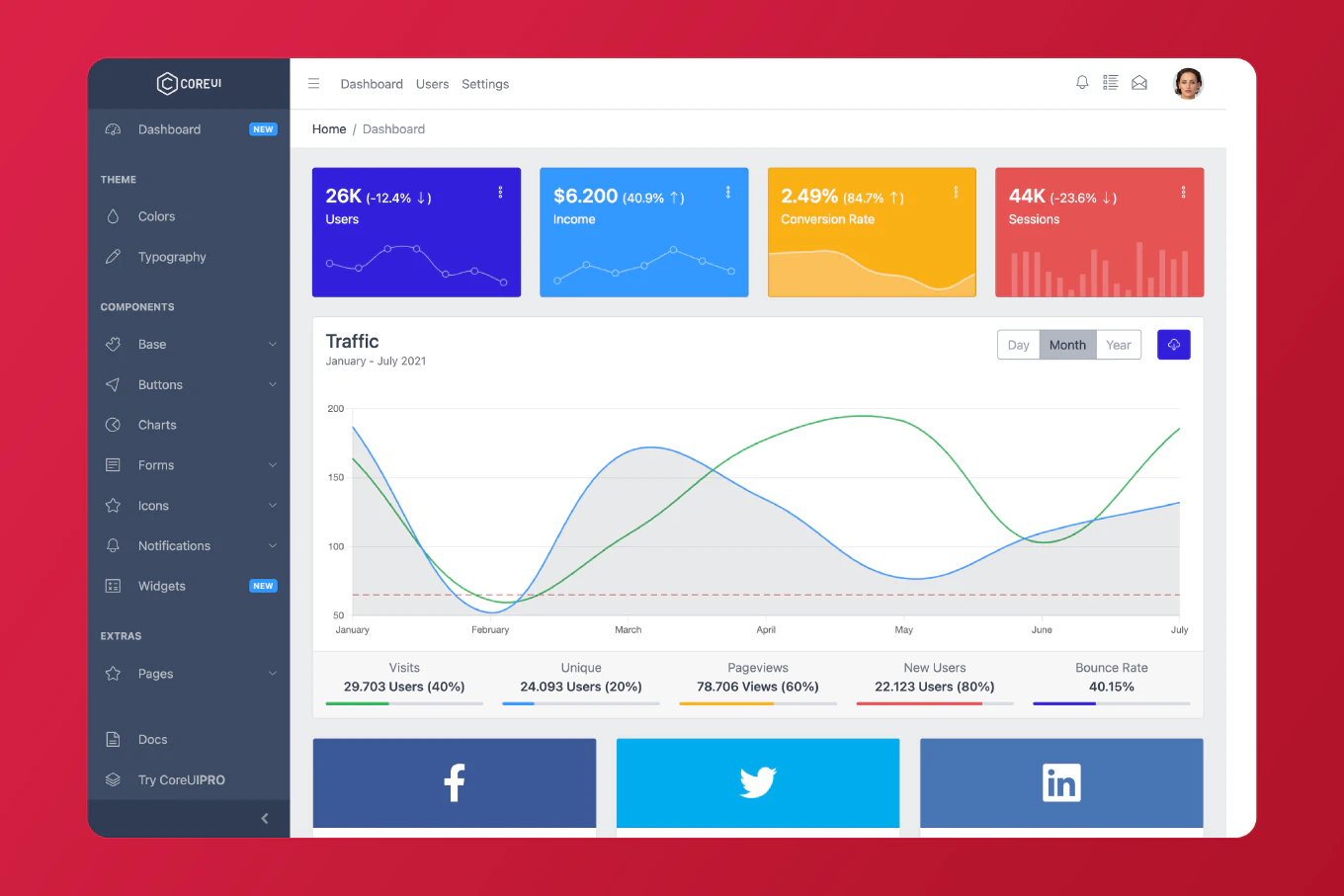
Dashboards are only as useful as the data they surface, but the charting infrastructure underneath them takes time to set up and style consistently. CoreUI Pro Next.js Boilerplate includes analytics and charting components integrated into the application structure and styled to match the UI foundation — no separate theming pass required.
The charts are ready to connect to your own data sources. Whether that means fetching from an internal API, reading from a database directly through a server component, or hydrating on the client, the presentation layer is already in place. Teams can focus on the data pipelines rather than on whether the chart colors match the rest of the interface.
For SaaS admin panels and operational dashboards where key metrics need to be visible at a glance, that integration shortcut translates directly into a faster first working version of the most important screens.
The types of products it helps launch faster
CoreUI Pro Next.js Boilerplate is a strong fit for any product where teams need secure access control, consistent navigation, and reusable building blocks from day one. The most common categories are:
Internal tools and back-office applications — where the audience is small, the trust boundary matters, and the team cannot afford to spend six weeks building the foundation before touching the actual business logic. Customer management tools, operations dashboards, support interfaces, and data entry screens all fit here.
SaaS admin panels — where the product ships with a customer-facing surface and a separate admin surface, and the admin side needs authentication, roles, and CRUD functionality without becoming its own six-month project.
Operational dashboards — where teams need to surface metrics, track activity, and manage records across multiple data sources in a consistent interface. The combination of charting, data tables, and role-based visibility makes CoreUI a natural fit.
Multi-team platforms — where different user personas need different views of the same underlying data. The RBAC layer handles the access logic so the team can focus on defining what each role should see rather than implementing the machinery that enforces it.
If your team is building in any of these categories, the CoreUI Pro Next.js Boilerplate reduces the time from project setup to working product by collapsing the foundational work into a starting point you can extend rather than rebuild.
What the from-scratch alternative actually costs
Teams sometimes underestimate the cost of the from-scratch path because they are thinking about the visible work — the screens, the components, the interactions. The less visible cost is the infrastructure work that every screen depends on: the auth layer, the access control model, the layout shell, the navigation system, the form and table patterns that every new feature needs to follow.
For a typical internal tool or admin panel, that foundational work can easily consume three to five weeks of a senior engineer’s time before a single product-specific feature is shipped. Done in parallel with product work, it still creates drag — decisions get deferred, inconsistencies accumulate, and the “clean up the foundation” task grows into a significant refactor.
Starting from CoreUI Pro Next.js Boilerplate means that sprint one begins with working authentication, access control, and a navigable shell rather than with scaffolding setup. The team’s first deliverable is a working feature, not a proof-of-concept foundation.
Why CoreUI deserves a place on the shortlist
The question teams should ask when evaluating any boilerplate is not just whether it saves time on day one. It is whether the foundation it provides is solid enough that they will not need to replace it once the application grows. A poorly structured starting point that ships fast becomes a liability the moment the requirements change.
CoreUI Pro Next.js Boilerplate is built on Next.js App Router conventions, Bootstrap, and React patterns that have broad community adoption and long-term support. The architecture follows conventions that new team members can orient to quickly rather than custom patterns that require internal documentation to understand. The component system is consistent, documented, and backed by an actively maintained design system.
That combination — fast setup and a maintainable foundation — is what puts CoreUI in a different category from minimal templates. It is a starting point that is still a good foundation twelve months into the project, not one that gets rewritten once the codebase grows past a certain size.
For teams evaluating admin dashboard templates for Next.js, the full comparison point is not just what the boilerplate includes on day one but what kind of codebase it produces over time.
Get started with CoreUI Pro Next.js Boilerplate
If your team is building an internal tool, admin panel, or operational dashboard and wants to skip the foundational setup phase, CoreUI Pro Next.js Boilerplate is the most direct path to a production-ready starting point with authentication, RBAC, data tables, forms, and analytics already in place.
Explore the full product at coreui.io/product/next-js-boilerplate/ to see the complete feature set, available demos, and pricing. If you are also evaluating other admin dashboard templates for Next.js, the admin dashboard themes and templates section covers the full CoreUI range.